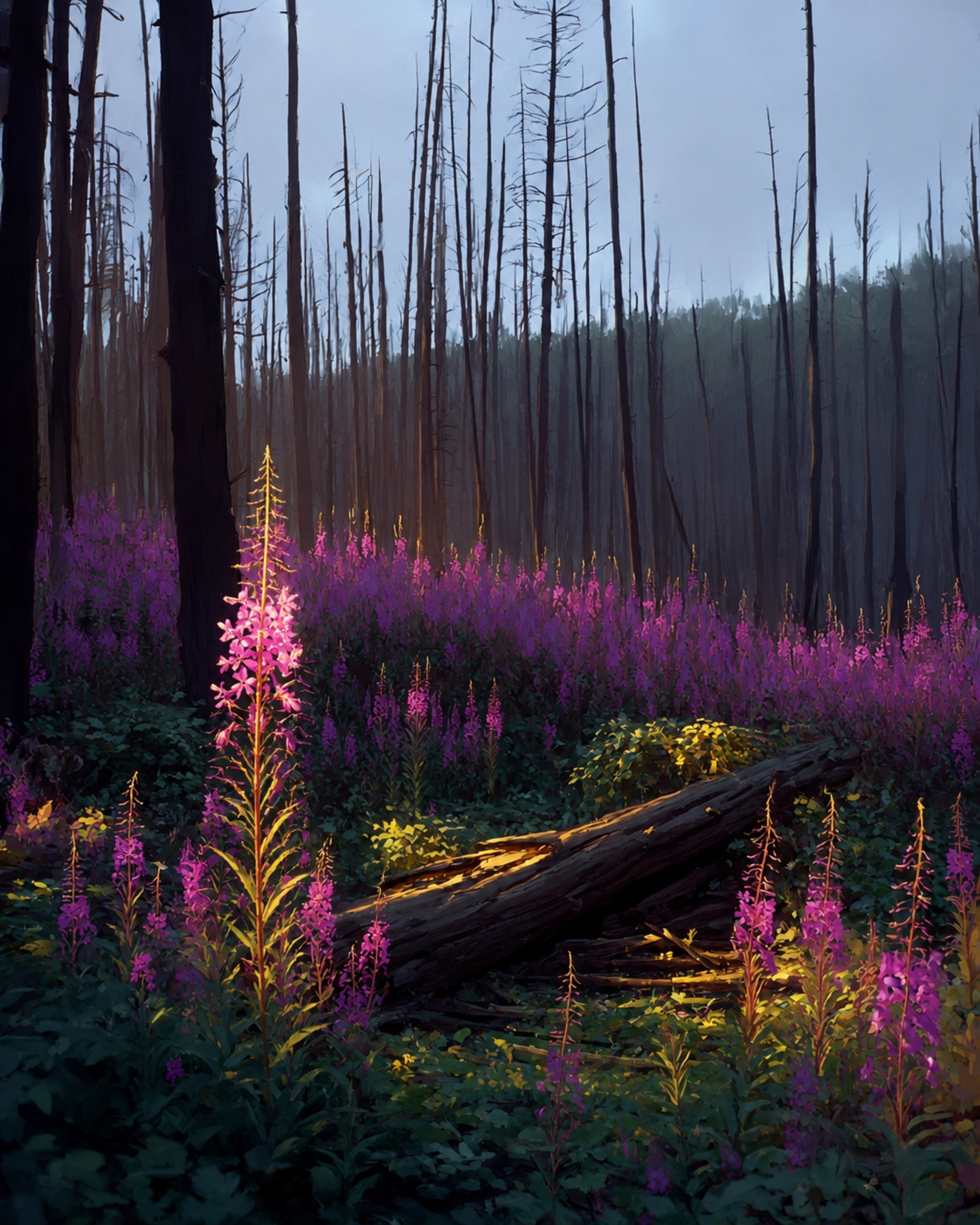
Walk through a young forest a few years after a wildfire and one plant seems to have stolen the show.
Fireweed.
Its brilliant magenta flowers blanket the hillside as if nature has chosen its hero.
It's easy to believe the fireweed rebuilt the forest.
I thought so too.
Then I kept looking.
Fireweed is remarkable.
It arrives quickly after disturbance.
Its seeds drift on the wind.
Its roots spread beneath the soil.
It stabilizes exposed ground, provides nectar for pollinators, returns organic matter to the earth and creates conditions that allow other species to establish themselves.
Without fireweed, the forest's recovery would look very different.
But something important is happening.
Fireweed isn't rebuilding the forest.
It's preparing the forest for someone else.
While our attention is drawn to the flowers, countless quieter relationships are already at work.
Fungi exchange nutrients beneath the soil.
Bees move pollen from flower to flower.
Moss begins carpeting fallen logs.
Shrubs shelter young seedlings.
Birds carry seeds.
Decomposers return yesterday's trees to tomorrow's soil.
Year after year, each species changes the environment just enough for another to arrive.
Eventually the canopy closes.
The shade deepens.
The fireweed begins to disappear.
Not because it failed.
Because it succeeded.
The conditions it helped create no longer require it.
Nature has an interesting way of defining success.
The species that first captures our attention isn't necessarily the one that receives the lasting reward.
The pioneer opens the door.
Stewardship builds the home.
I wonder if our culture sometimes forgets that.
We celebrate founders.
Inventors.
Disruptors.
Visionaries.
Firsts.
History remembers the person who found the path.
Far less often do we celebrate the people who quietly cared for it over the decades that followed.
The teacher who shaped generations of students.
The quality manager who prevented problems no one ever noticed.
The parent who showed up every day.
The farmer who improved the soil for someone they would never meet.
The neighbour who quietly made a community stronger.
Their work is rarely dramatic.
It's cumulative.
Invisible.
Patient.
And absolutely essential.
Innovation matters.
Without pioneers, there would be no new paths to follow.
But pioneers alone cannot grow forests.
Ideas are fragile.
Businesses are fragile.
Communities are fragile.
Even relationships are fragile.
They don't endure because someone had a brilliant idea.
They endure because someone kept making thousands of small decisions that honoured that idea long after the excitement had faded.
Perhaps that's what stewardship really is.
Not maintaining the past.
Creating the conditions for life, people and ideas to continue flourishing.
I used to think the hero of the forest was the fireweed.
Now I think the forest was quietly teaching a different lesson.
The fireweed found the path.
Stewardship grew the forest.
And maybe that's true of the things we hope will outlive us.
Not businesses.
Not families.
Not communities.
Not even ideas.
None of them are built by heroes alone.
They're built by relationships.
They're sustained by care.
They're measured not by who began them, but by whether they continue to thrive long after the pioneer has disappeared.
Maybe that's why nature seems so patient.
It isn't trying to create heroes.
It's growing stewards.